
Raising investment for a startup takes seven steps. Prepare the materials: concept, financial model, offer and pitch deck. Build a list of suitable investors.
Reach them through introductions, platforms and events. Hold meetings. Pass the investor’s due diligence. Agree a term sheet and the agreement. Close the deal and report regularly.
Raising funds is a complex task that requires a precise approach, strategic planning and high-quality documentation.
Below is the whole process step by step, with a detailed look at one outreach channel — the international platform Vestbee.
It shows exactly what investors want to see and where founders most often lose their interest.
Step 1. Prepare your materials
Without materials, an investor conversation is spent on things you could have shown in advance. The minimum set:
- a project concept and roadmap;
- a financial model — where the money goes, on what, when it pays back;
- an offer to the investor: how much you are raising, on what terms, what the investor gets;
- a pitch deck — a short project presentation;
- metrics, if you already have them: revenue, MRR (monthly recurring revenue), growth, traction.
Preparation step by step: How to prepare a startup for investment.
If your valuation is low and you have no collateral to offer: Investor-ready offers: low pre-money, no collateral.
Step 2. Build an investor list
Writing to everyone is pointless: every investor has their own stages, sectors, geography and ticket sizes.
First define the investor type by your stage — business angels, funds, corporate investors, equity crowdfunding.
Then compile a list of specific investors currently backing similar projects; you can see it from their latest deals.
How to do this and where to look, including in Spain: How to find an investor for a startup.
Step 3. Reach out to investors
The main channels:
- introductions — a referral from a mutual contact, another founder or an adviser beats a cold email;
- angel networks and accelerators — they select projects and bring them to investors themselves;
- events — pitch sessions, industry conferences, investor days;
- platforms that connect startups and investors. Let’s look at one of them, Vestbee, in detail.
Platform example: Vestbee
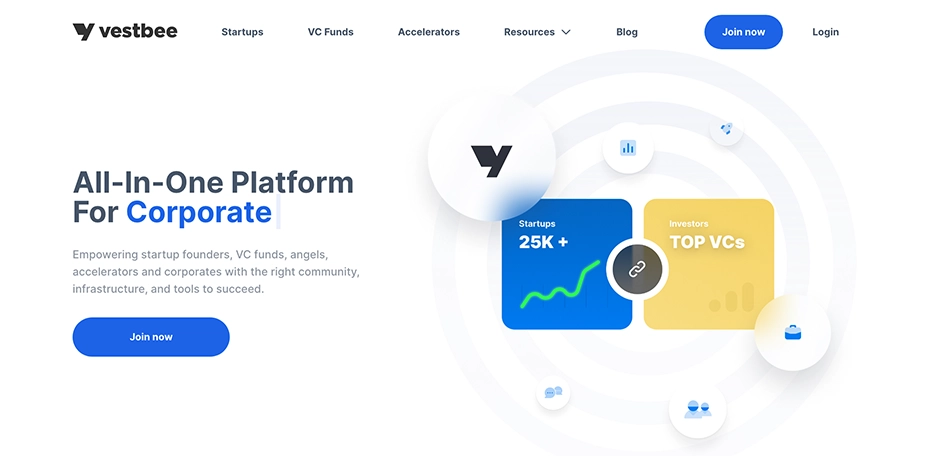
Vestbee helps startups find investors and reach their financial goals by connecting founders, business angels and venture funds internationally.
What the platform offers:
- access to investors — business angels, venture funds and corporates interested in new projects;
- startup support — advice, resources and tools to prepare for investor negotiations;
- ease of use — the main functions are quick to learn.
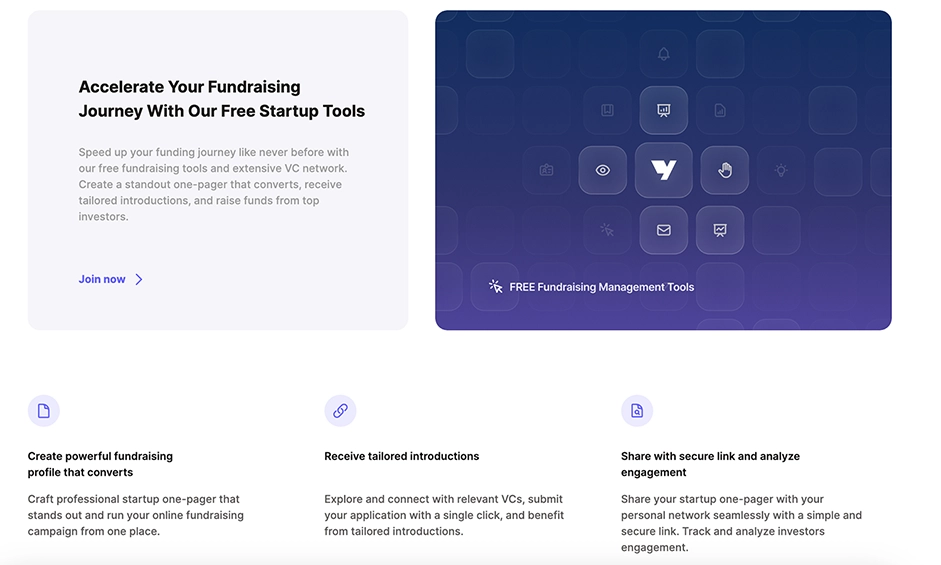
The platform’s free tools help you:
- create a startup one-pager;
- apply to funds in one click and receive tailored introductions;
- share your profile via a secure link and see how investors engage with it.
Challenges of working on your own. At first glance Vestbee is convenient, but with high competition and a lot of information, breaking through and attracting an investor is hard. Founders face three difficulties:
- limited access to investors interested specifically in their project;
- lack of time and experience to prepare materials and manage the profile properly;
- difficulty making the profile attractive, which lowers the response rate.
The platform needs a strategic approach and time for a profile to stand out. It is important not only to know all the features but to use them well.
How to create and optimise a profile
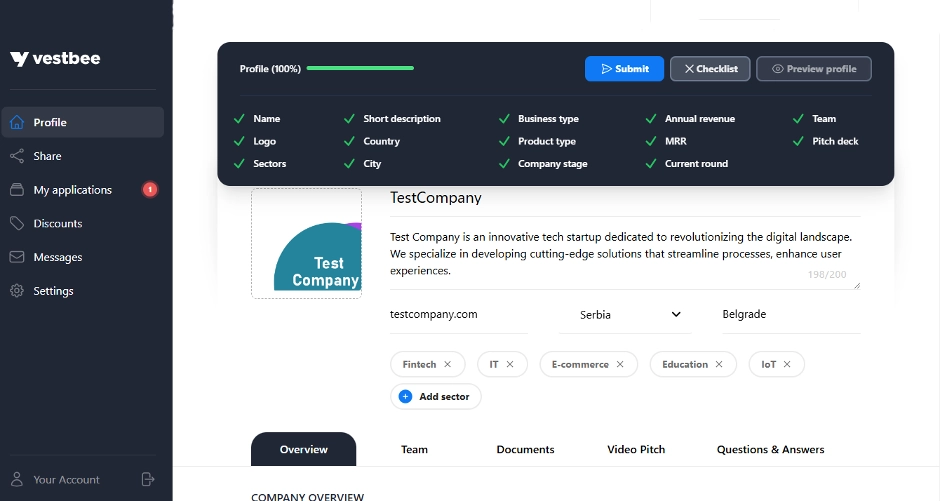
1. Registration and basic information. Fill in the key company data:
- name and logo;
- sector and business type;
- startup stage, country and city.
A concise but informative description improves the chances of attracting attention.
2. Financial information and project data. Provide clear, up-to-date data:
- annual revenue and MRR — venture funds use them to assess growth;
- current round — the stage and the amount you want to raise;
- documents — a pitch deck and materials that show the potential clearly.
3. Optimising the profile for investors.
- Wording: not just facts but the company’s strengths — it makes the project stand out.
- Different investors: both business angels and large funds use the platform, so the profile should address the interests of different audiences.
Applying for a new funding round
In the funding application section, specify correctly:
- round type — matching the startup’s stage;
- round size — the amount you plan to raise;
- Already committed — how much has been raised;
- Committed investors — companies or business angels who have already backed the project;
- Security — the instrument, such as equity or convertible debt. How each works in a Spanish SL: How to structure startup investment in Spain.
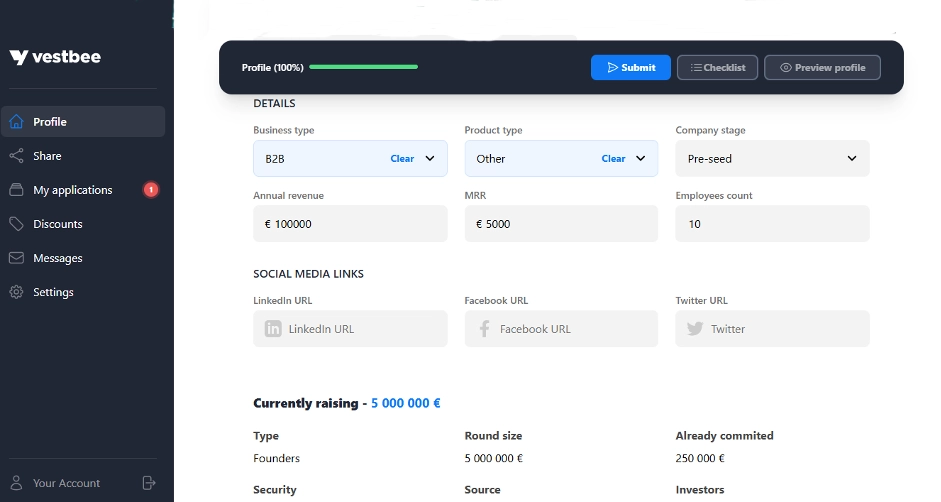
How easily investors can assess your potential and stage depends on the accuracy and completeness of this data.
The numbers in the profile must match the financial model: an investor who gets to due diligence will compare them.
Keep the profile up to date
To keep investors interested, update the profile regularly and respond to feedback:
- update revenue and key metrics;
- refine the data on the round and next stages;
- add new pitch decks, metrics and progress news.
When something changes, investors are notified, which keeps their engagement with the project alive.
Partner offers
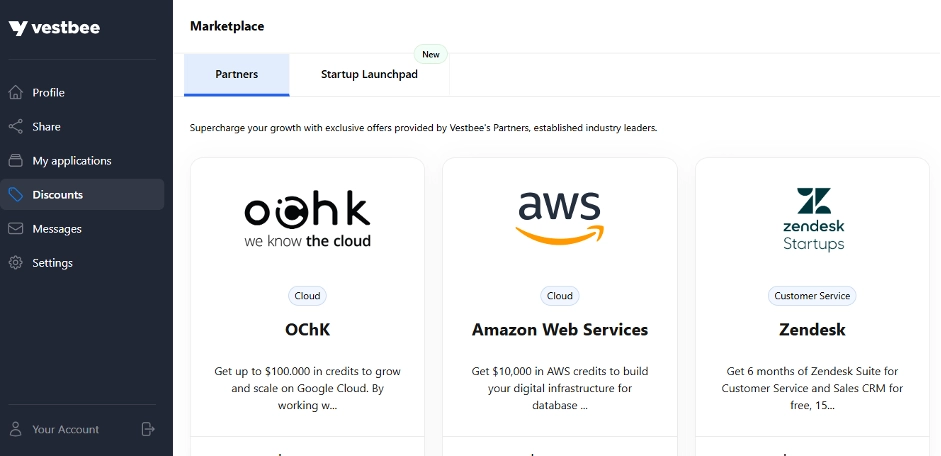
Vestbee also offers partner deals that cut early costs: cloud credits (AWS, Google Cloud through partners) and Zendesk for customer support and sales.
They are not investment, but infrastructure savings extend your runway.
Vestbee is a powerful tool, but using it well takes a precise, comprehensive approach — from the profile to the application and continuous updates.
It is time-consuming and requires knowing the platform’s nuances. A platform does not replace preparation — it only shows it to investors.
Step 4. Hold the meetings
A first meeting is a short pitch and questions. The investor assesses the team, market, product, numbers and whether you understand your business.
A good meeting ends with a next step: a follow-up, a data request, an introduction to the fund’s partners. How to prepare: Preparing for investor meetings.
Step 5. Pass due diligence
Before the deal the investor checks what you have shown: the financial model and actuals, contracts, product rights, cap table, team.
This is where gaps between the deck, the platform profile and the model surface — better to find them yourself first.
How investors review projects: Choosing a startup for investment: an investor’s perspective.
Step 6. Agree the term sheet and agreement
A term sheet is a short document with the key terms: amount, valuation, stake, instrument, investor rights, milestones.
It is agreed before the legal agreement, so lawyers formalise what has already been settled.
In Spain an investor’s entry into an SL’s capital is executed before a notary and registered at the Mercantile Registry; convertible loans and SAFEs need adapting to Spanish law — see How to structure startup investment in Spain.
Step 7. Close and report
After signing, the money comes into the company and the investor’s stake is recorded in the capital.
The deal does not end there: regular investor reports — plan versus actual, cash, key metrics — keep trust and make the next round easier.
From practice
The process most often breaks at step 1, not at finding investors.
In the Pandora eco-hotel project, an investor was ready to put in around €12m at seed stage, but the deal depended on meeting their conditions — land, architects, a 6-year financial model, approvals from the authorities — and we brought the project to those conditions.
With the ImSkipper marketplace, the work began with a plan, a concept and the numbers for scaling; without them there is nothing to talk to an investor about.
Frequently asked questions
Where do you start raising investment for a startup?
With materials: a concept, financial model, offer and pitch deck. Then a list of investors who back your stage and sector. Searching without preparation wastes your most valuable first contacts.
How long does raising investment take?
Usually months: preparing materials, finding and meeting investors, due diligence, agreeing terms and paperwork. Plan the round so your money lasts through the whole period with a margin.
Do platforms like Vestbee help find investors?
They help you reach investors and present the project in a structured way: profile, numbers, round details. But a platform does not replace preparation: with high competition, projects with clear numbers and strong materials stand out.
What does an investor check before a deal?
The financial model and actuals, contracts, product and IP rights, the cap table and the team. Everything shown in the deck and profile must be backed by documents.
What is a term sheet?
A short document with the key terms of the deal: amount, valuation, stake, instrument, investor rights and milestones. It is agreed before the legal agreement so lawyers formalise terms already settled.
Key points about raising investment
- Seven steps: materials, investor list, outreach, meetings, due diligence, term sheet and agreement, closing and reporting.
- Introductions, angel networks and accelerators work better than cold emails.
- Platforms like Vestbee widen access to investors but do not replace preparation.
- The numbers in the deck, profile and financial model must match — investors will check.
- In Spain an investor’s entry into an SL’s capital is executed before a notary and registered at the Mercantile Registry.